

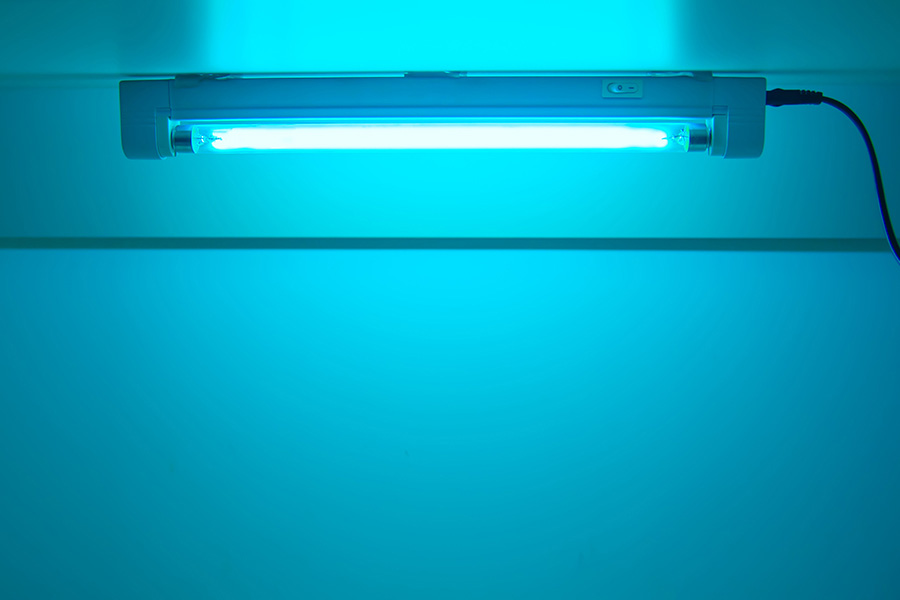
UV lights are a worthwhile addition for Keller homeowners dealing with musty odors, mold on the evaporator coil, or ongoing respiratory irritation, because germicidal UV-C keeps microbial growth off the wet surfaces inside your HVAC system. They are a supplement to filtration and ventilation, not a replacement for either. Based on what we see in Keller homes, coil-mounted UV is most valuable in houses that run long cooling seasons with high humidity, which describes most of North Texas from May through September. Here is an honest look at what UV does, what it does not, and how to decide.
Why Should Keller Homeowners Consider UV Lights?
Keller homeowners should consider UV lights because the evaporator coil inside your air handler stays wet for months at a time, and a wet, dark, dust-laden surface is the ideal environment for mold and bacteria to establish. UV-C light installed at the coil interrupts that growth cycle continuously.
The local climate is what makes this relevant. Long humid cooling seasons mean your coil rarely dries out completely, and a coil that never dries is a coil that accumulates biological growth season after season.
Reducing that growth has a direct air quality effect. Anything living on the coil sits directly in the airstream, so it gets distributed to every room the system serves, every time the blower runs.
There is a system performance benefit as well. Biological film on a coil acts as insulation, reducing heat transfer and airflow. Keeping the coil clean supports both efficiency and capacity.
UV-C is a well-established technology in healthcare and laboratory settings for surface disinfection, and coil-mounted residential systems apply the same principle to a smaller, more targeted surface. Understanding how UV light air purification fits alongside filtration is the key to setting realistic expectations.
How Do UV Lights Improve Indoor Air Quality?
UV lights improve indoor air quality primarily by keeping the surfaces inside your HVAC system clean rather than by sterilizing the air passing through it. That distinction matters, and it is where most marketing gets misleading.
Air moving through a duct passes a UV lamp in a fraction of a second. Meaningful inactivation of airborne organisms requires a specific dose, meaning intensity multiplied by exposure time, and a brief pass through a duct delivers far less dose than a surface sitting under the lamp continuously.
The coil, by contrast, is exposed to the lamp constantly. That is where UV-C does its most reliable work, preventing mold and bacterial film from establishing on the wet fins and in the drain pan.
The downstream benefit is what homeowners actually notice. A clean coil means no musty smell when the system starts, better airflow, and less biological material being carried into living spaces.
For airborne particles, pollen, dust, dander, and fine particulate, filtration remains the correct tool. Pairing coil-mounted UV with HEPA-rated filtration covers both problems, because each addresses something the other cannot.
Households with allergy sufferers often report the biggest improvement from that combination during the Keller allergy seasons in spring and fall.
What Are the Real Benefits of HVAC UV Lights?
The real benefits of HVAC UV lights are a cleaner coil, reduced musty odors, better maintained airflow, and less biological material circulating through the home. Those outcomes are consistent and observable.
Preventing microbial growth on the coil and in the drain pan is the primary function. A drain pan that stays clear also drains properly, which prevents the water overflow problems that cause ceiling damage in attic installations.
Efficiency follows from cleanliness. A coil free of biological film transfers heat at the rate it was designed to, which shortens run times and reduces wear on the compressor and blower.
Equipment life benefits for the same reason. A system running its designed cycles under designed conditions lasts longer than one fighting a restricted, fouled coil through every North Texas summer.
Temperature consistency improves modestly as a result of maintained airflow, particularly in larger homes where the system was already working near capacity.
What UV will not do is substitute for the rest of your air quality strategy. A complete approach still includes filtration, correct ventilation, humidity control, and periodic cleaning, and a proper indoor air quality assessment is what identifies which of those your home actually needs.
Are There Drawbacks to Installing UV Lights?
Yes, there are real drawbacks worth weighing. UV systems carry an upfront cost, require ongoing bulb replacement, deliver limited benefit against airborne particles, and can be ineffective if installed incorrectly.
Cost and ongoing maintenance are the practical considerations. Lamps lose output over time and typically need replacement on an annual or biannual schedule, depending on the model. A lamp that is still glowing is not necessarily still producing effective germicidal output.
Ozone deserves an accurate explanation. Standard germicidal lamps operating at 254 nanometers do not generate significant ozone. Certain lamps operating at shorter wavelengths do, and ozone is a respiratory irritant at elevated concentrations. If ozone is a concern for your household, specify an ozone-free germicidal lamp and confirm the specification rather than assuming.
Installation quality determines effectiveness entirely. A lamp mounted where it does not illuminate the coil surface, or positioned too far from it, produces very little benefit while still consuming power and requiring replacement.
Scope limitations are the most important thing to understand. UV does not remove dust, pollen, dander, or particulate, and it does not address gases or odors from sources outside the HVAC system. Expecting it to solve a whole-house air quality problem on its own leads to disappointment.
Weighed honestly, UV is a good value for the specific problem it solves and a poor value if bought as a general air purifier.
How Do You Choose the Right UV Light System?
Choose a UV system based on what you are trying to accomplish, whether the lamp physically illuminates the target surface, and how much maintenance you are willing to keep up with. Those three questions eliminate most of the confusion.
- Type of UV system: Coil sanitizing systems mount at the evaporator coil and target surface growth, which is the application with the strongest evidence behind it. Air sanitizing systems mount in the duct and attempt to treat passing air, which requires substantially more output to be meaningful.
- Sizing and compatibility: The lamp needs adequate output for the coil surface area, correct mounting distance, and physical space inside your air handler cabinet. Not every cabinet accommodates every system.
- Maintenance requirements: Look for accessible lamp placement and a clear replacement schedule. A lamp buried in a position that requires disassembling the air handler tends to go unreplaced, at which point you are paying for electricity and getting nothing.
Safety is a real installation consideration too. UV-C causes eye and skin injury on direct exposure, so systems need proper shielding and service interlocks, which is a substantial argument for professional installation over a self-install kit.
A technician can assess your specific coil, cabinet, humidity levels, and existing filtration, then tell you whether UV addresses your actual problem or whether something else should come first.
Frequently Asked Questions
How often do HVAC UV bulbs need to be replaced?
Most residential germicidal lamps are rated for roughly one to two years of continuous operation, depending on the model. Output degrades gradually, so a lamp can still emit visible light while producing too little germicidal intensity to be effective. Following the manufacturer’s replacement interval rather than waiting for the lamp to go dark is the correct approach.
Are HVAC UV lights safe for my family in Keller, TX?
Properly installed systems are safe because the lamp is enclosed inside the air handler or ductwork, where nobody is exposed to direct UV-C. The safety concerns arise during service, which is why systems should include shielding and why lamp replacement is best handled by a technician. Direct UV-C exposure causes eye and skin injury even in short durations.
Do UV lights get rid of dust and pollen?
No. UV-C inactivates biological organisms but does nothing to particulate matter. Dust, pollen, dander, and fine particles require mechanical filtration. If your primary complaint is dust or seasonal allergies, filtration and duct sealing will do far more for you than UV.
Will a UV light fix a musty smell in my house?
If the musty smell originates from mold on the evaporator coil or in the drain pan, coil-mounted UV addresses the source directly and typically resolves it. If the smell comes from moisture elsewhere in the house—a crawl space, a leak, a damp wall cavity, or a duct running through humid attic space—UV at the coil will not reach it. Finding the source first is the difference between a fix and an expense.
Do I still need to change my air filter if I have UV lights?
Yes, and the filter arguably matters more. UV addresses biological growth on surfaces inside the system, while the filter captures the particulate that would otherwise coat the coil and feed that growth. The two work together, and neglecting the filter undermines the UV system’s effectiveness.
Making the Right Air Quality Call for Your Keller Home
UV lights are a targeted solution to a specific problem: microbial growth on the wet surfaces inside your HVAC system. For homes fighting musty odors, a persistently dirty coil, or humidity-driven growth through a long North Texas cooling season, they earn their place. For general dust and allergy complaints, filtration and ductwork come first. If you want a straight assessment of what your home actually needs, book a consultation and we will start with what we find rather than what we sell.